
The Arapahoe County Directory Shelf
The historical Arapahoe County city directory record is spread across Denver Public Library, municipal museums, a genealogical society, and cataloged digital collections. No single all-residents volume covers every municipality and year. A city directory search starts by naming the place as the old volume named it, then checking the collection’s scope before treating a missing result as evidence that a person was absent.
| Collection | Years | Where Held | Access |
|---|---|---|---|
| Denver Public Library city directories | 1873 onward, with gaps and undigitized years | DPL Western History and Genealogy | Research A-Z, physical and digital holdings |
| DPL householder directories | 1924-1937 | Denver Public Library | Address-order research; Denver-focused suburban check required |
| Corbett & Ballenger, Vol. 2 by address | 1887 | DPL digitized collection | Collection and digitized links |
| XL Western Arapahoe County directory | 1932, Vol. 2 | DPL, STX-2 shelf | Catalog and physical shelf lead |
| XL Suburban, Arapahoe County District Section E | 1939 | DPL, STX-2 | Alphabetical and householder sections in person |
| Aurora, Colorado City Directories, XL Directory Service | 1953, 1955, 1957, 1959, 1962 | Aurora History Museum records and survey leads | Research request or supervised appointment |
| XL suburban directory catalog | 1957 and 1961 holdings confirmed | FamilySearch catalog 146029 | Catalog access; image availability varies |
The table is a set of confirmed leads, not an uninterrupted Arapahoe County run. DPL describes Denver directories from 1873 onward, while the local XL volumes identify Western Arapahoe County, Englewood, Fort Logan, Garden Home, Littleton, Sheridan, and related districts. Aurora’s dates come from an official landmark-survey lead. The FamilySearch catalog confirms selected holdings, not every year between them.
Note: Directory years are collection leads, so a missing scan should be checked against the DPL index and the holding institution before drawing a conclusion.
Arapahoe County City Directories by Year
Publisher and locality matter. The 1932 Western Arapahoe County volume includes Englewood, Fort Logan, Garden Home, and Littleton alongside county material, a buyer’s guide, and avenues and streets in towns and county areas. The 1939 XL Suburban volume uses an Arapahoe County District section that includes Fort Logan, Garden Home or Westwood, Littleton, Loretto, and Sheridan or Petersburg.
The 1887 Corbett & Ballenger set is useful because its volumes split the work into alphabetical, by-address, and occupation or statistics material. DPL’s householder volumes from 1924 through 1937 give another address-first route. For an Aurora search, use the five confirmed years as targets rather than assuming that an unlisted year was never printed or held.
DPL’s Colorado Directories Index is the catalog step before a shelf request. It is organized by municipality, county, and year and includes city directories and telephone books. That index can identify a volume even when the volume itself is not digitized, and it helps distinguish a missing scan from a missing publication.
Arapahoe County Library Access for Historical Directories
Arapahoe Libraries Genealogy & Local History offers Colorado History materials, one-on-one librarian help, and the digitized “Rearview Mirror” collection of audio, video, and images. Its resource page also describes Ancestry Library Edition as an in-library database with no library card needed, plus newspaper resources that can supply obituary, marriage, club, and address clues.
The library district does not serve Aurora, Englewood, or Littleton. That boundary is a research instruction, not a minor catalog detail. Aurora material should move to the Aurora History Museum, Englewood material to the Englewood Public Library, and Littleton material to the Littleton Museum Research Center. A directory search that stays inside one library system can miss the exact city section needed.
The library image below represents the local-history access route. Staff help can identify a shelf, a database, or a nearby collection, but the year and municipality still need to be stated in the request. See the Arapahoe Libraries genealogy source for the collection and reference route.
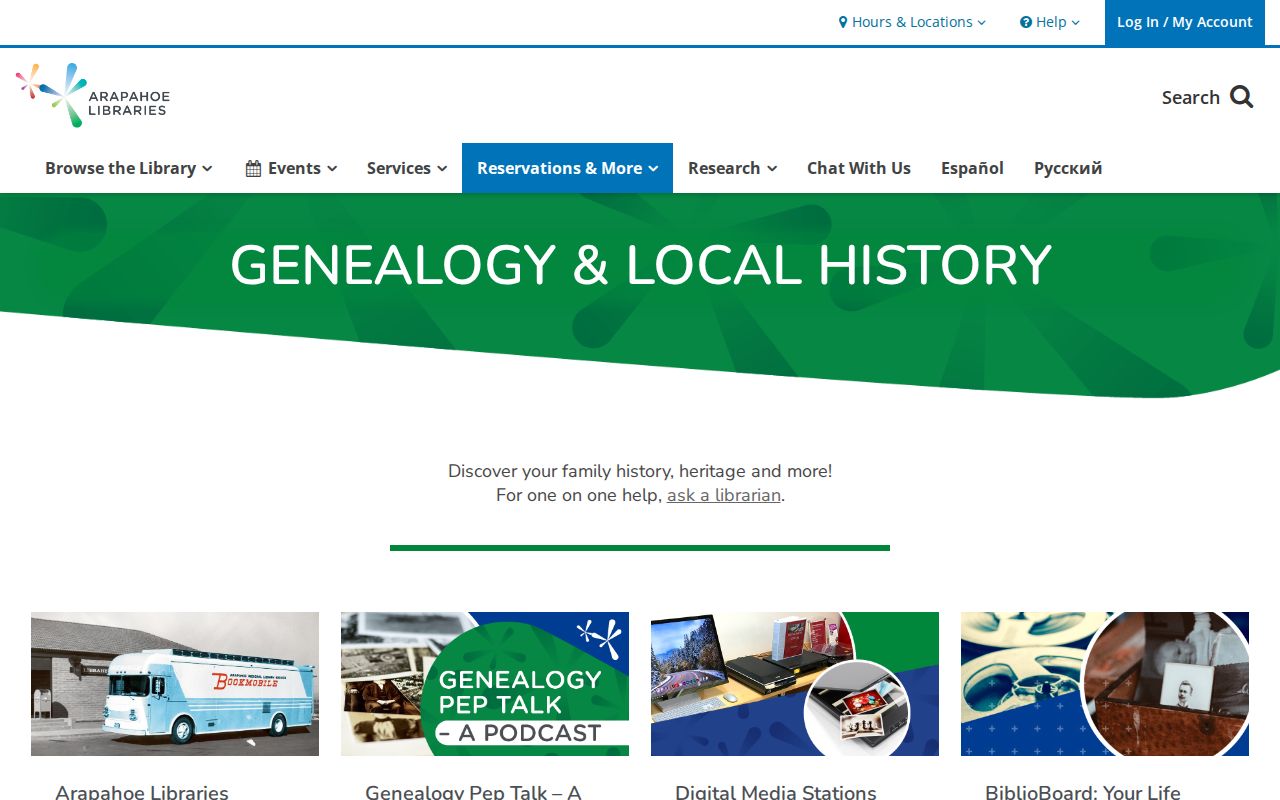
The district exclusion for Aurora, Englewood, and Littleton remains important after a library search succeeds, because those cities have their own historical custodians.
Aurora Archive Access for Arapahoe County Directories
The Aurora History Museum archival research route provides finding aids, supervised research, digitized historic newspapers, and historic survey material. Requests and appointments can take up to two weeks and may involve fees. The museum is at 15151 E Alameda Pkwy, Aurora, Colorado 80012, and the research contact route lists 303-739-7000.
Aurora’s city-directory dates are especially useful as a search plan: 1953, 1955, 1957, 1959, and 1962. The official survey confirms the years and XL Directory Service lead, but the exact physical call number was not located. State the city, year, person or street, and desired finding aid when contacting the museum rather than asking for a broad resident list.
The archive image below shows the supervised research route for an Arapahoe County city directory question. Use the museum’s archival research page when a finding aid or historic newspaper is the next source.
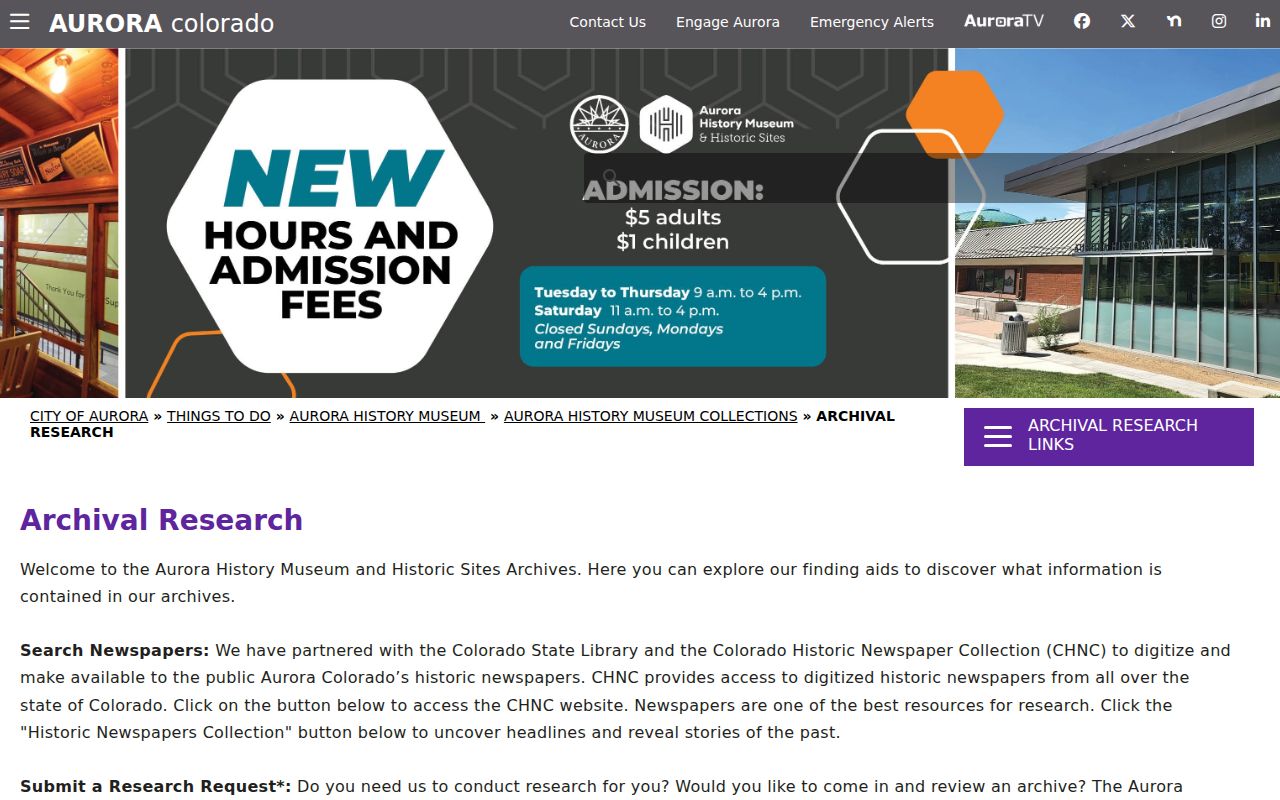
Archival research is supervised and historical. A newspaper page, survey, or directory reference can point to a person or property without proving present residence, so the museum route belongs beside the directory volume, not in place of it.
Note: Aurora research requests can take up to two weeks, so include the municipality, year, street, person, and desired finding aid.
Reading Arapahoe County City Directory Entries
A 1915 Corbett & Ballenger item in the DPL digital collection is 1,886 pages long and shows how much information can sit inside one short line. A typical entry may combine an indexed name, a title or marital marker, an occupation or business role, a residence or business address, and a room or board note. The line is compact, so punctuation and abbreviations carry real meaning.
| Indexed name | Surname and given name, sometimes with Miss or Mrs. and initials |
|---|---|
| Trade or occupation | Printed role or business reference, when the volume supplies one |
| Address | Residence or business location, which may appear in both sections |
| Residence marks | r for residence, rms for rooms, and b for boards in the inspected example |
| Household markers | Spouse or name-in-parentheses notation, widow markers, and related cross-references |
- Criss-cross directory
- An address-order section that lets a researcher start with a street and number instead of a surname. It can list an occupant, boarder, or business without proving ownership.
- Householder index
- An address-focused list of owners, residents, or businesses. DPL’s 1924-1937 householder run is Denver-focused, so suburban scope must be checked.
- Abbreviation key
- The front matter that defines local marks. Photograph or transcribe it before reading a run, because 1915 marks should not be applied automatically to the 1932 or 1939 XL volumes.
OCR is only a lead. Confirm street numbers, initials, punctuation, and the difference between r and rms against the page image and a neighboring year. The city directory line should be cited with its volume, page, locality label, and publication year.
Arapahoe County’s Criss-Cross Directory Method
Address-first searching is the bridge between a property question and a name. In 1887, Corbett & Ballenger’s Vol. 2 arranged entries by address. DPL’s 1924-1937 householder run continued the reverse approach, while the 1932 and 1939 XL volumes added local street and householder material for Arapahoe-area districts.
Read the street section first, record the line and page, then check the alphabetical section for the same name. A person may have a residence address and a business address, or may appear as a boarder rather than the person associated with the property. A criss-cross hit is an historical address clue, not a title record.
Trace Households in Arapahoe County City Directories
A household trail works best when each entry is treated as a dated source. Keep the old street spelling, district name, volume, page, and every household marker. A city label such as Western Arapahoe County, Garden Home or Sheridan/Petersburg may be the link between a historical line and a modern parcel.
- Start with the exact number and street spelling from the period source or a modern parcel record, then test the matching address section.
- Record the name, spouse or widow marker, trade, address, page, and whether the line says residence, rooms, or boards.
- Move through nearby years and check the alphabetical section. Do not skip from one decade to the next when an annual directory is available.
- Pair directory years with census years and newspaper notices. The 1950 census is public, while the 1960 census is not public in 2026.
- Use an obituary, marriage index, cemetery ledger, probate file, deed, or permit to explain a move or a name that disappears.
A missing entry can mean a move, death, an unlisted person, a changed district label, or a gap in the collection. When a historical name needs a current record check, use the separate Arapahoe County resident lookup sources and keep the directory’s fixed publication date in view.
Note: A household marker identifies a printed relationship or status clue, not a legal statement about title or present occupancy.
Arapahoe County Directory OCR and Census Checks
The 1915 DPL item pairs page images with OCR, making it quick to search but easy to misread. Initials, street numbers, punctuation, and the marks for residence, rooms, and boarding can all be distorted. The page image is the controlling evidence for a transcription, especially when a surname appears in more than one place.
| Checkpoint | What It Adds |
|---|---|
| 1873 onward DPL run | Long Denver directory context and a route into the Colorado Directories Index |
| 1887 Vol. 2 and 1915 digitized item | By-address method, page images, OCR, and entry conventions |
| 1924-1937 householder years | Address-order continuity, with a Denver-focused scope check |
| 1932 and 1939 XL volumes | Western Arapahoe and district-specific resident and street material |
| 1950 census and later directories | Public household checkpoint; 1960 census schedules remain unavailable in 2026 |
| Aurora 1953-1962 and FamilySearch 1957/1961 | Confirmed local targets without assuming a complete annual run |
The census supplies household composition and birthplace fields that a directory may omit, while the city directory supplies an annual address bridge. Newspapers, deeds, and probate then help explain a change instead of turning a single line into a full life story.
The 1902 Arapahoe County Directory Story
Arapahoe County was one of Colorado’s original 17 counties, created while the area was Kansas Territory. Denver was the original county seat until the 1902 county division, after which Littleton became and remains the county seat. That history matters when a directory, court reference, or newspaper uses “Arapahoe County” in a way that does not match a modern boundary.
The record geography still has a visible split between Denver-area collections and local municipal holdings. A directory entry may use a suburban district, a town name, or a county section rather than the city label a researcher expects. Pair the wording in the volume with the street guide, legal description, and historical map before deciding that two names describe different places.
Arapahoe County Directory Companion Indexes
Directories become stronger when a second local source supplies an event or family link. The Columbine Genealogical & Historical Society hub points to Arapahoe County marriage indexes for 1940-1965, published in three volumes, and more than 8,000 burial records from two ledgers covering 1869-1981. Its indexed Littleton United Methodist records add another place-based clue.
Columbine’s holdings are an index and research lead, not a substitute for a certified record. The local result should be tied to the directory year, page, cemetery or marriage entry, then checked with the responsible custodian when a formal copy is needed.
The genealogy society image below represents that local index layer. See the Columbine genealogy holdings for the society’s marriage, burial, and church-record route.
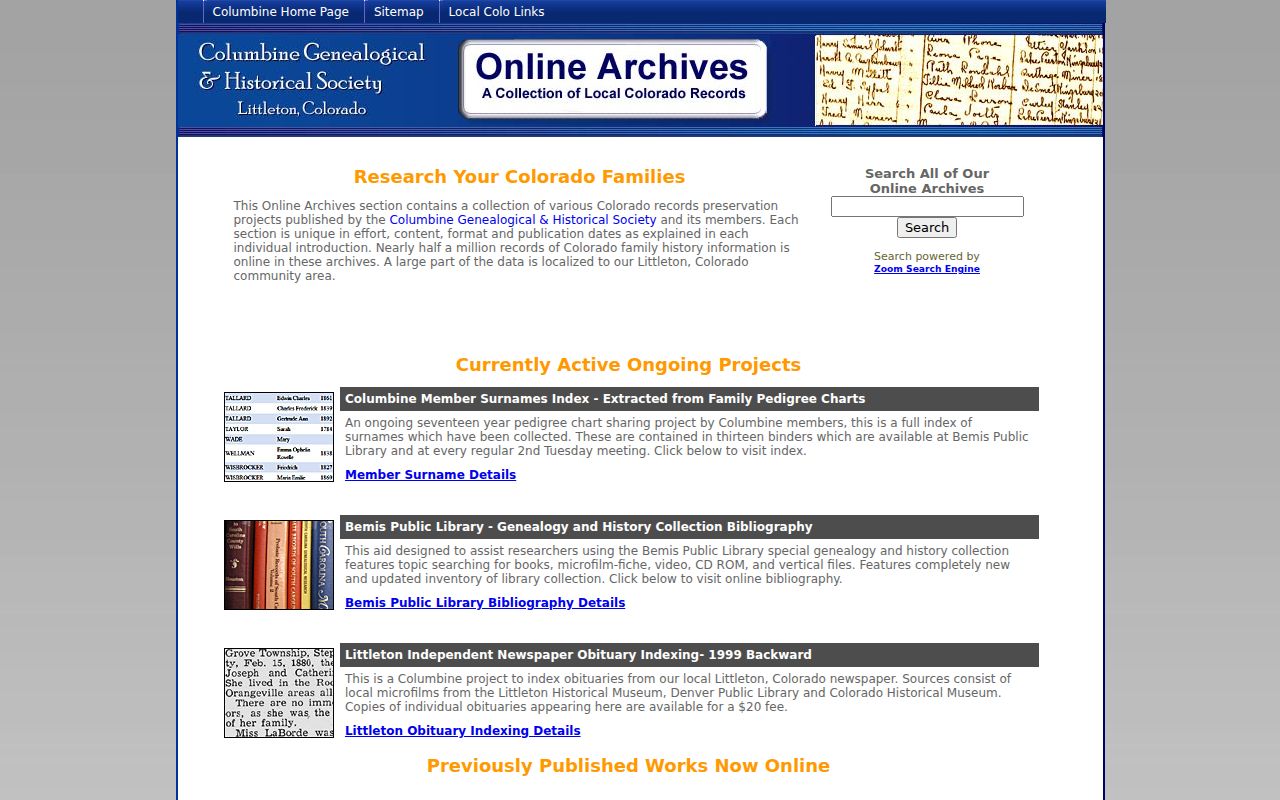
The burial ledgers can keep an older name trail moving when a modern death certificate is restricted, while the directory preserves the address and household context.
Note: Columbine index entries help locate a source, while certified copies remain with the responsible custodian.
Englewood and Littleton Directory Context
Englewood’s “Share Your Heritage” collection, at 1000 Englewood Pkwy with reference help at 303-762-2560, adds interviews, photographs, newspapers, local clubs, and organization records from 1969 onward. It is a local-history collection, not a searchable countywide resident directory.
Littleton Museum research is appointment-only and offers newspaper microfilm, maps, oral histories, and people, business, church, school, and farm files at 303-795-3954 or history@LittletonCo.gov. These separate access channels matter because Arapahoe Libraries does not serve Littleton, Englewood, or Aurora. State the exact city and period when requesting a file.
For older county, court, or vital record groups, use State Archives finding aids and the Denver reference desk at 1313 Sherman St, Denver, 303-866-2358. Reading-room access and copy rules depend on the record group. A county-held historical file that is not in a library collection can be requested through the Arapahoe County CORA policy with a specific office, place, year, record type, and desired format.